Events & consulting / Case study
Consumer Healthcare Summit
A clear platform for an industry conversation.
Explore the live website(opens in a new tab)- Sector
- Events & consulting
- Audience
- Consumer healthcare leaders, delegates & partners
- Project focus
- Event positioning · Programme discovery · Registration journeys
01 / The context
The brand behind the website.
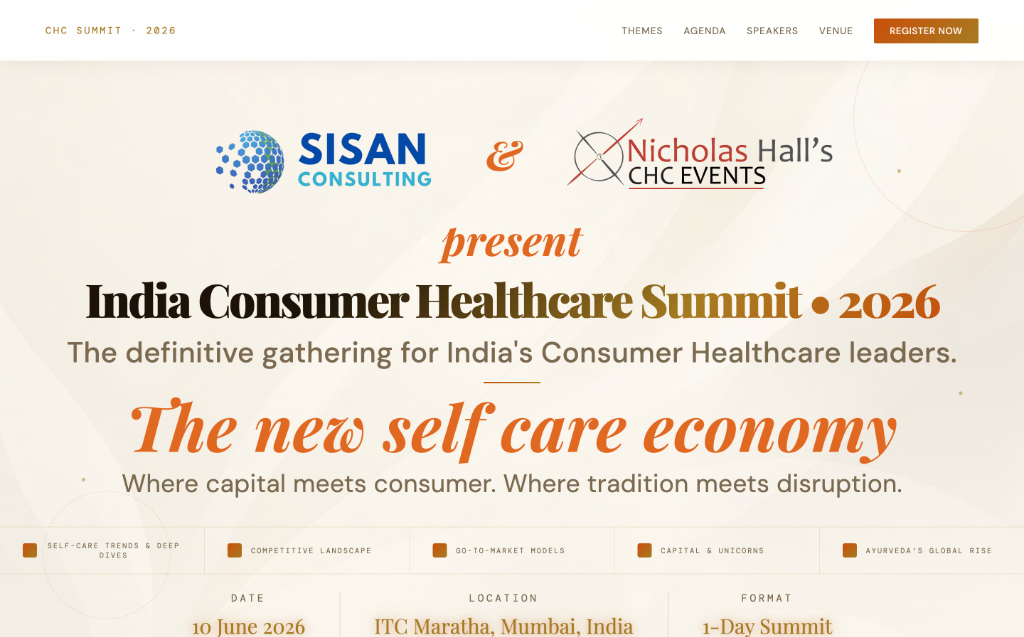
Presented by SISAN Consulting and Nicholas Hall's CHC Events, the Consumer Healthcare Summit brings industry leaders together around the future of self care.
02 / The objective
What the experience needs to do.
Turn a detailed industry programme into a clear reason to attend.
An event website must answer several questions quickly: what is the event, who is it for, what will be discussed and how can someone participate? The design needs to accommodate a substantial programme while keeping the central proposition and the registration path easy to find.
03 / The approach
The thinking behind the design.
An editorial headline and a warm palette introduce the event. Prominent themes, speakers, agenda and venue links help visitors explore the programme, with registration clearly signposted.
Establish the event and its organisers first
The opening composition brings the organising brands, event name and central theme together. An editorial headline and warm palette give the summit a distinct identity, while the key event information gives visitors an immediate point of orientation.
Separate the programme into useful layers
Themes, agenda, speakers and venue information have distinct roles in the page structure. Visitors can first understand the subjects being discussed, then move into the programme in more detail. Top-level navigation allows a specific question to be answered without reading the entire page.
Offer different routes for different interests
Delegate registration and partnership enquiries are presented as separate actions. Each path asks for information relevant to that type of participation. The design makes participation visible without replacing the programme content that helps visitors decide whether to take part.
04 / The visitor journey
From first impression to next step.
Understand the summit
The introduction identifies the event, its organisers and the industry conversation at its centre.
Assess the programme
Themes and agenda sections help visitors judge the relevance of the discussions.
Plan participation
Speaker and venue information add context for delegates considering attendance.
Choose a route
Separate registration and partnership forms guide the two main participation journeys.
05 / In the website
Details that make it work.
Anchored event navigation
Direct routes to themes, agenda, speakers, venue and registration.
Layered programme content
A broad thematic overview followed by the more detailed session schedule.
Venue information
Location context and a map route support attendance planning.
Two participation forms
Distinct entry points for delegate registration and partnership enquiries.
06 / The delivered experience
An event website that brings the programme, organisers and registration journey into one coherent experience.
The website gives a content-rich summit one coherent digital home. Event positioning, programme detail and participation paths work together, helping visitors move from an initial understanding of the event to a relevant registration or partnership enquiry.
Next case study / Wellness
Fēza Wellness
A calm digital home for practical well-being.
Explore the project